Step up from tritiya: lashings, estimation, navigation, first aid, campcraft, signaling, service & leadership. Each module has a quick lesson, demo, quiz, and a fun fact.
Progress:
Jump To
Complete tritiya Sopan Syllabus
Work through these 12 modules in order. Mark your progress by answering each module’s mini-quiz. Saved locally on your device.
Module 1 — Advanced Patrol Leadership & Service Projects
Goal: Upgrade from basic patrol work to full-on leadership — plan, execute, and review multi-step service projects while guiding younger scouts.
Intro Video
Learning Objectives
Define advanced patrol roles & responsibilities.
Design a 2-4 week service project using SMART + D.O.G.
Conduct effective patrol meetings and handle conflict.
Apply risk-assessment (RAM) before every field activity.
Measure results & write a project report.
Core Concepts
1) Leadership = Process not Position
Small decisions daily build trust — plan 40%, coach 30%, logistics 20%, admin 10%.
Inform base camp of departure & expected return time.
Stay hydrated; 15-minute break every hour.
Stop immediately in case of injury or bad weather.
Advanced Challenges
Do a night navigation practice with glow-sticks & bearings of 45°, 135°, 225°, 315°.
Make a contour model from cardboard showing hill and valley patterns.
Conduct a 2-day expedition with camp stay and log book entries.
Assessment (20 points)
Route map accuracy — 4
Compass use & bearings — 4
Team discipline & safety — 4
Log book clarity — 4
Presentation & reflection — 4
Reflection Questions
What was the hardest part of navigation?
Which equipment was most useful and why?
How did the team handle fatigue or conflict?
What natural feature did you discover on the way?
Mini Quiz
Answers (for leader): 1) 4 P’s = Purpose, Planning, Preparation, Performance 2) Back bearing = add/sub 180° 3) 1 cm = 250 m means map scale.
Fun fact: Robert Baden-Powell’s first Boy Scout camp on Brownsea Island (1907) included a 1-day navigation hike — the start of modern expeditions.
Module 4 — First Aid & Emergency Transport
Goal: Prepare scouts to react calmly and correctly during accidents or illness — giving first aid until medical help arrives and learning safe methods to move casualties.
Intro Video
Learning Objectives
Explain the aims and principles of first aid (Preserve Life, Prevent Worsening, Promote Recovery).
Demonstrate treatment for common injuries and emergencies.
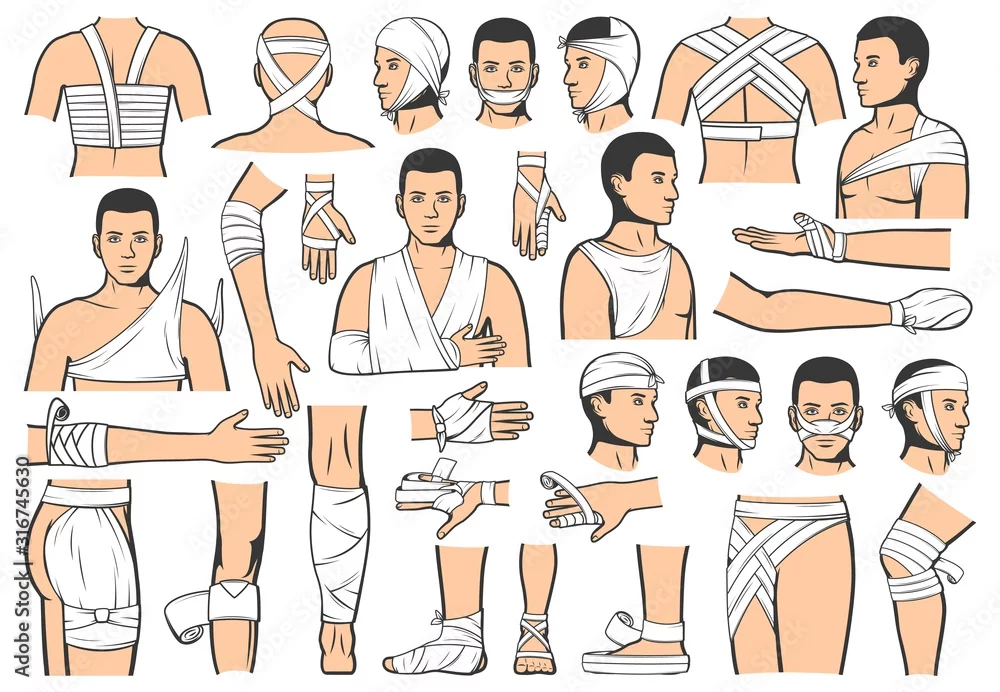
Use bandages, slings, and splints properly.
Describe and apply the steps of CPR and recovery position.
Show safe casualty transport methods using stretchers or improvised equipment.
Check response: gently shake shoulder + ask “Are you okay?”
Open airway: head tilt, chin lift.
Look–Listen–Feel for breathing (10 s).
Call for adult/medical help immediately.
2) Golden Rules
Stay calm — panic spreads faster than help.
Use clean cloth / gauze for wounds.
Never move a fracture victim unless area is unsafe.
Keep the casualty warm and reassured.
Common Emergencies & Treatment
Emergency
Signs
Immediate Action
Bleeding (Wound)
Blood flow visible
Apply pressure → Raise part → Bandage firmly
Nose Bleed
Blood from nose
Head forward → Pinch soft nose → Cold compress
Fracture
Pain, swelling, deformity
Immobilize with splint → Pad → Send for help
Burn/Scald
Red/blistered skin
Cool under running water 10 min → Cover loosely
Shock
Pale, weak pulse
Lay down → Raise legs → Keep warm → No food/drink
Snake Bite
Puncture marks + pain
Keep still → Tie firm band above bite → Hospital immediately
Step-by-Step — CPR for Unconscious Adult
Check DR ABC.
Call for help / ambulance.
Place heel of hand center of chest → compress 30 times (100–120 per min).
Give 2 breaths if trained and safe to do so.
Continue 30:2 cycles until help arrives or breathing returns.
Emergency Transport Methods
Human Crutch: One rescuer supports injured person’s arm over shoulder.
Two-Hand Seat: Two rescuers carry light casualty sitting.
Four-Hand Seat: Two rescuers lock hands to form a chair.
Stretcher: Use wooden poles + blanket or shirts to make improvised stretcher.
Safety Checklist for First Aiders
Use gloves if available — avoid contact with blood.
Do not use cream on burns.
Never give unconscious person water or food.
Record time of incident and actions taken.
Assessment (20 points)
Knowledge of DR ABC — 4
Bandaging & Slings — 4
CPR Technique — 4
Transport Method — 4
Calmness & Leadership — 4
Reflection Questions
Which emergency scared you most and why?
How did you keep yourself calm while acting?
What improvement can you make next time?
Mini Quiz
Fun fact: The Red Cross symbol originated in 1863 — chosen as the reverse of the Swiss flag to honour neutrality and protection in war.
Module 5 — Citizenship, Duty to Nation & Environment
Goal: Understand what it means to be an active, responsible citizen — loyal to the nation, respectful to all, and committed to protecting the environment.
Intro Video
Learning Objectives
Describe the qualities of a good citizen and the duties given in the Constitution of India.
Explain the Scout Law in connection with civic responsibility and social harmony.
Demonstrate respect for national symbols — Flag, Anthem, and Constitution.
Plan and conduct one local environmental action or awareness project.
Recognize how everyday choices affect the planet.
Core Concepts
1) Duties of a Citizen (Article 51-A, Constitution of India):
Abide by the Constitution and respect its ideals.
Cherish freedom-struggle values.
Protect unity, integrity, and sovereignty of India.
Defend the country and render national service when called.
Protect environment, public property, and heritage.
Develop scientific temper, compassion, and spirit of inquiry.
2) The Scout’s Role as a Citizen
Practice the Daily Good Turn — small civic habits build a better society.
Respect elders, obey laws, and help community safety initiatives.
Serve without expecting reward; honour the national symbols.
3) Environment & Sustainable Living
Reduce single-use plastic and conserve water.
Participate in tree-plantation and cleanliness drives.
Understand waste segregation and recycling symbols.
Activity 1 — Civic Awareness Project
Select a local issue (cleanliness, road safety, heritage care).
Meet one civic officer or local volunteer to understand challenges.
Create a poster or short awareness video.
Present findings in patrol meeting and post to school board.
Activity 2 — Green Pledge & Audit
List five eco-friendly habits your patrol will follow for one month.
Track compliance weekly (e.g., no litter, bring steel bottle).
Calculate carbon-saving impact using online calculator.
Assessment (20 points)
Understanding of civic duties — 4
Respect for national symbols — 4
Project execution — 4
Environmental awareness — 4
Reflection & teamwork — 4
Reflection Questions
What does patriotism mean to you beyond flag hoisting?
How can scouts influence others to protect the environment?
Goal: Learn the art of living comfortably and safely outdoors — setting up functional camps, managing resources, maintaining hygiene, and mastering outdoor cooking.
Learning Objectives
Pitch and maintain a tent safely and neatly.
Organize a patrol campsite (sleeping, cooking, waste zones).
Demonstrate hygiene, fire safety, and weather preparedness.
Cook nutritious meals using minimum equipment and fuel.
Apply Leave-No-Trace and eco-camping principles.
Core Concepts
1) Tent Pitching & Layout
Select high, dry, and shaded ground.
Face tent door away from wind direction.
Use groundsheet to prevent dampness.
Mark camp zones: tent line, kitchen area, fire circle, latrine pit, waste pit.
2) Fire Safety & Cooking Zones
Clear 2 m radius around fire.
Keep bucket of sand/water nearby.
Use tripod or trench fire depending on ground.
Extinguish fully before leaving.
3) Outdoor Cooking Techniques
Foil Cooking: Wrap food (like potatoes, corn) in foil and place in embers.
Stick Cooking: Use sharpened green stick for roasting bread or marshmallows.
Trench Stove: Small ditch with air holes, saves fuel and hides fire from wind.
Solar Cooker: Cardboard box + foil = zero-fuel eco cooking.
Activity — “Build Your Patrol Camp”
Step 1: Draw a layout plan (zones, fire area, waste pit, flag post).
Step 2: Pitch tent using correct pegs and knots.
Step 3: Build gadgets — shoe rack, wash stand, or fire tripod using lashings.
Step 4: Cook a simple meal (rice + curry + salad) using trench or tripod fire.
Bury biodegradable waste, pack non-biodegradable back to base.
Keep a handwashing station using a tippy-tap (jerrycan + stick pedal).
Maintain a camp logbook (weather, menu, duty roster).
Advanced Challenge Ideas
Construct a kitchen shelter using bamboo and tarp.
Invent a low-smoke cook stove with recycled tins.
Design a camp meal plan for 2 days (budget + nutrition chart).
Assessment (20 points)
Tent pitching & knots — 4
Camp layout & hygiene — 4
Cooking & taste — 4
Team coordination — 4
Safety & cleanup — 4
Reflection Questions
What was hardest about setting up camp?
Which cooking method saved the most fuel?
How did you manage waste responsibly?
Mini Quiz
Answers (for leader): 1) Foil cooking uses embers 2) Tippy tap = water saving wash station 3) Fire safety = 2 m clearance + bucket ready.
Fun fact: The word “Campcraft” was coined by Baden-Powell — it means the art of living happily with nature, using skills, not gadgets.
Module 7 — Signalling & Communication Skills
Goal: Master traditional and modern communication methods so a scout can send clear messages even without digital tools.
Intro Video
Learning Objectives
Demonstrate Morse code and semaphore signalling for letters A–Z.
Use basic field signals: whistle, hand, and flag codes.
Send and decode short messages using light or sound.
Understand clarity, timing, and confirmation in communication.
Apply radio or walkie etiquette where available.
Core Concepts
1) Morse Code — Dots & Dashes
Each letter = unique pattern of short (dit) and long (dah) sounds or flashes.
Example: A = · – , B = – ··· , C = – · – ·
Use torch, whistle, or knocks for practice.
2) Semaphore — Flags Talk
Two flags held at fixed angles form each letter.
Hold steady; move arms smoothly between signals.
Sender faces receiver; message confirmed by reply signal “K” (acknowledge).
3) Field Signals & Whistle Codes
One short blast — Stop / Attention
Two short blasts — Forward
Three short — Danger / Emergency
Continuous — Rally back to leader
Practical Activity — “Message Relay Challenge”
Form patrol pairs 20 m apart; use semaphore to send a 3-word message (e.g., “Meet at Base”).
Record time taken and number of errors.
Repeat using Morse flashlight or whistle; compare speed & accuracy.
Optional: create a night version using torches and cardboard shields.
Modern Communication Add-on
Learn radio basics: call-signs, “Over” & “Roger” etiquette.
Use walkie-talkies with clear channel protocols.
Understand communication hierarchy in emergencies (leader → HQ → medical).
Assessment (20 points)
Morse accuracy — 4
Semaphore technique — 4
Field signal use — 4
Team coordination — 4
Clarity & confirmation — 4
Reflection Questions
Which method felt most natural to you?
How does communication discipline affect safety?
How could these skills help in disasters?
Mini Quiz
Answers (for leader): 1) Morse uses dots & dashes 2) Semaphore = flags at angles 3) Three short blasts = danger.
Fun fact: During WWII, scouts were trained as signal messengers — some delivered codes faster than early telegraph lines!
Module 8 — Estimation, Mapping & Compass Mastery
Goal: Develop the ability to estimate distances, read and draw maps, and use a compass for direction-finding and navigation during camps, hikes, or emergencies.
Intro Video
Learning Objectives
Estimate height, width, and distance using pace, stick, or shadows.
Understand symbols, scales, and contour lines on topographic maps.
Draw a simple route or sketch map using correct orientation.
Use the magnetic compass for bearings and directions.
Navigate a short course using map and compass together.
Core Concepts
1) Estimation Techniques
Pace Count: Count steps for 100m, calculate your average.
Stick Method: For tree height — hold stick at arm’s length equal to its height and measure using triangle similarity.
Shadow Ratio: Compare shadow of known object to unknown one for height estimation.
Rope & Landmarks: Use known-size objects (like poles) for width or gap estimation.
2) Map Reading Essentials
Map Scale: Ratio of map distance to ground distance.
Symbols: Represent features like roads, rivers, buildings, etc.
Contours: Brown lines showing height and land shape.
Legend: Explains map symbols and colors.
Grid References: Locate points using coordinates (e.g., 34/67).
3) Compass Mastery
Parts: Base plate, needle, dial, direction arrow.
Hold compass flat, align north needle with orienting arrow.
Fun fact: Scouts were among the first youth groups in the world to practice triangulation — a technique still used in GPS mapping today!
Module 9 — Community Service & Social Awareness
Goal: Build awareness and compassion through meaningful service that improves lives, supports communities, and spreads the true spirit of scouting.
Intro Video
Learning Objectives
Understand the purpose and ethics of community service.
Plan and execute a social awareness or service project.
Identify local problems and work with civic bodies or NGOs.
Develop teamwork, empathy, and leadership in real-life contexts.
Report, document, and reflect on completed service activities.
Core Concepts
1) What is Community Service?
Voluntary work done to benefit others or the environment.
Builds cooperation, selflessness, and civic sense.
Develops gratitude — understanding what others go through.
2) Forms of Service
Environmental: Tree plantation, waste segregation, clean drives.
Educational: Teaching younger kids, running book donation camps.
Health: Awareness on hygiene, blood donation, or first-aid help.
Social: Helping old-age homes, orphanages, or special-needs centers.
Disaster Relief: Collecting clothes, food, and assisting in camps.
Activity — “Serve for Change Project”
Step 1: Identify one issue in your area (like waste or lack of trees).
Step 2: Plan a small, realistic project (2–5 hours).
Step 3: Inform local authorities or headmaster for support.
Step 4: Execute it with your patrol or school team.
Step 5: Record photos, reflections, and impact report.
Project Ideas (For Patrols)
“Green Path” — Mark a 1 km stretch with dustbins and trees.
“Hygiene Heroes” — Awareness on handwashing and personal care.
“Smile Kits” — Make small gift packs for orphanage kids.
“Traffic Warriors” — Help police manage crossings during rush hour.
“Care for Strays” — Build or donate feeding bowls for animals.
Documentation
Write a one-page report with title, objective, method, results, and reflection.
Attach 2–3 photos as proof of participation.
Present your project during troop meeting.
Assessment (20 points)
Planning & execution — 4
Team coordination — 4
Community impact — 4
Documentation — 4
Reflection & discipline — 4
Reflection Questions
What was the most rewarding part of your service?
How can a small project make a big difference?
What values did you learn through teamwork?
Mini Quiz
Answers (for leader): 1) Service = selfless act 2) Environmental service = tree plantation 3) Traffic aid = civic responsibility.
Fun fact: Baden-Powell once said, “The happiest people are those who make others happy.” Service is the truest form of leadership.
Module 10 — Scouting Spirit: The Journey Comes Full Circle
Goal: Reflect on the Scout Promise & Law learned at Pravesh, demonstrate how these values guide action, and celebrate the patrol’s growth with a completion badge and a practical plan to keep the Good Turn alive.
Quick link — Back to Pravesh
Pravesh laid the foundation. If you want to revisit the original basics, jump back: Open Pravesh section — or
Short reflection summary
Pravesh taught the Promise, the Law, and the Good Turn. Tritiya brought skills, responsibility and leadership. Module 10 ties them together: you don’t only know the words — you show them by action. This module helps scouts turn values into habits.
Core Elements — condensed
Promise in practice: One concrete act per day for 21 days (the Good Turn chain).
Law in habit: Pick 3 laws to focus on this term (e.g., helpful, polite, thrifty).
Leadership as service: Small daily leadership acts — wake patrol on time, keep area clean, mentor a junior scout.
Activities — turn values into action
21-day Good Turn chain: Each scout logs one small Good Turn per day for 21 days. Use the patrol logbook or a shared spreadsheet.
Promise Presentation: Patrol prepares a 5-minute skit or poster showing what the Promise means to them today.
Law Check-in: Weekly 5-minute circle where each scout says one example of living the Law that week.
Celebrate — Completion Badge & Certificate
When a scout completes the 21-day Good Turn chain + one service project, they earn the Tritiya Scouting Spirit badge. Use the button below to mark completion and print a simple certificate (opens print dialog).
Good Turn Log (sample)
Use this minimal log to collect entries for 21 days — one line per day.
Saved entries are kept in your browser localStorage (only on this device).
Reflection Prompts (for report)
How did keeping one Good Turn each day change your outlook?
Which law was easiest to follow? Which was hardest?
One moment you felt proud to be a scout.
Teacher / Leader Notes
Encourage honesty — small acts count more than showy gestures.
Collect 2 photos per scout group as evidence for the badge.
Use the final patrol meeting to present certificates publicly to build culture.
Mini Quiz
Answers (for leader): 1) Promise practice = Good Turn chain 2) Focus 3 laws for the term 3) Evidence = photos + logbook.
Final note: Pravesh started a promise. By living it through actions, your scouts finish a circle — skills + heart = true scouting.