Pratham Sopan — Learn by Doing

This page covers the complete Pratham Sopan. Each module has crisp notes, images or demos, a mini-quiz, and a fun fact. Your progress is saved locally.

Progress:

Jump To

🌟 Complete Pratham Sopan Syllabus

Each module is like a mini-course: Read, Watch, Try, and Quiz. Every ✅ adds to your progress!

1 — Drill & Patrol System

Drill builds discipline, unity, and confidence. Scouts learn to stand in correct positions, move in harmony, and respond quickly to commands. Patrol System ensures teamwork where each patrol has its own leader and identity.

  • Standing: Attention, Stand at Ease
  • Turns: Left, Right, About Turn
  • Saluting: On march and halt
  • Patrol System: PL, APL, Court of Honour, patrol calls & flags

💡 Fun fact: Baden-Powell called the Patrol System the “backbone of Scouting.”

2 — Daily Good Turn & Service

A Scout proves their promise daily through small acts of kindness. Keep a diary and note each good turn. Over time, this habit shapes your character and builds responsibility.

  • Helping parents at home
  • Guiding younger children
  • Keeping environment clean
  • Conserving resources like water & electricity

💡 Fun fact: The World Scout Badge has a knot at the bottom — a reminder to do a Good Turn daily!

3 — Scout Law & Promise (Practical)

Knowing the Scout Promise and living by the Law is at the heart of Scouting. Each point guides behavior in real life, whether at school, home, or community.

  • Trustworthy, loyal, helpful
  • Friendly, courteous, kind to animals
  • Obedient, cheerful, thrifty
  • Pure in thought, word & deed
Scout making promise

💡 Fun fact: The three fingers in the Scout Sign represent Duty to God, Duty to Others, Duty to Self.

4 — First Aid (Bleeding, Burns, Fractures)

First Aid skills save lives. Scouts must act quickly and calmly in emergencies.

  • Bleeding: Apply pressure, elevate
  • Burns: Cool water 10–20 min, never ice
  • Fractures: Immobilize with splints, avoid movement
  • Fainting: Lay flat, raise legs
  • Nosebleeds: Pinch soft nose, head forward

💡 Fun fact: The Red Cross symbol is used worldwide — but Scouts often train with triangular bandages because they can do almost anything!

5 — Knots & Lashings

Knots and lashings are essential in camping and pioneering. They allow Scouts to build gadgets, tie shelters, and secure loads safely.

  • Knots: Reef/Square, Sheet Bend, Clove Hitch, Bowline, Timber Hitch
  • Lashings: Square (for frames), Diagonal (for bracing), Shear (for tripods)
  • Tips: Keep spacing neat, tighten with fraps, always dress your knot properly

💡 Fun fact: The Bowline is called the “King of Knots” because it forms a fixed loop that never slips yet unties easily.

6 — Pioneering (Simple Gadgets)

Pioneering is the art of building useful structures with staves and ropes. It teaches teamwork, planning, and practical knotting skills.

  • Examples: wash stand, shoe rack, dustbin stand
  • Steps: plan design → collect materials → assign roles → build safely → tidy up
  • Always check lashings are tight and stable
Scout pioneering gadget

💡 Fun fact: The real strength in lashings comes from fraps — the tight loops that pull ropes together.

7 — Estimation & Observation

Scouts learn to make quick estimates of distance, height, width, and time, using simple methods without instruments.

  • Pace count: measure distance with your steps
  • Thumb rule: estimate height by thumb alignment
  • Shadow method: find height using shadow ratio
  • Kim’s Game: memory game for observation

💡 Fun fact: With practice, Scouts can estimate distances within 10–15% accuracy using only paces!

8 — Mapping & Trail Signs

Maps and trail signs guide Scouts in the outdoors. They prevent getting lost and help patrols communicate silently.

  • Draw a sketch map of your school or neighbourhood
  • Include landmarks, north arrow, legend
  • Learn trail signs: arrows, circles, stones, sticks
Scouting trail signs

💡 Fun fact: Trail signs are like a secret Scout language that only trained eyes can read!

9 — Campcraft & Cooking

Campcraft skills make outdoor life comfortable and safe. Cooking in camp teaches self-reliance and teamwork.

  • Tent pitching basics: site selection, staking, pegging
  • Fires: teepee, log cabin, star fire
  • Simple cooking: poha, khichdi, noodles, chapati
  • Clean up camp and extinguish fire safely
Scouts cooking on campfire

💡 Fun fact: The smokiest wood is green wood — always look for “dead, dry, down” sticks for good campfires.

10 — Environment & Sanitation

Scouts care for nature and practise cleanliness wherever they go. Leave every place better than you found it!

  • Follow Leave No Trace principles
  • Segregate waste: wet, dry, recyclable
  • Keep latrines and facilities hygienic
  • Organise a short clean-up drive
Scouts cleaning environment

💡 Fun fact: “Leave No Trace” has 7 principles, and Scouts worldwide follow them!

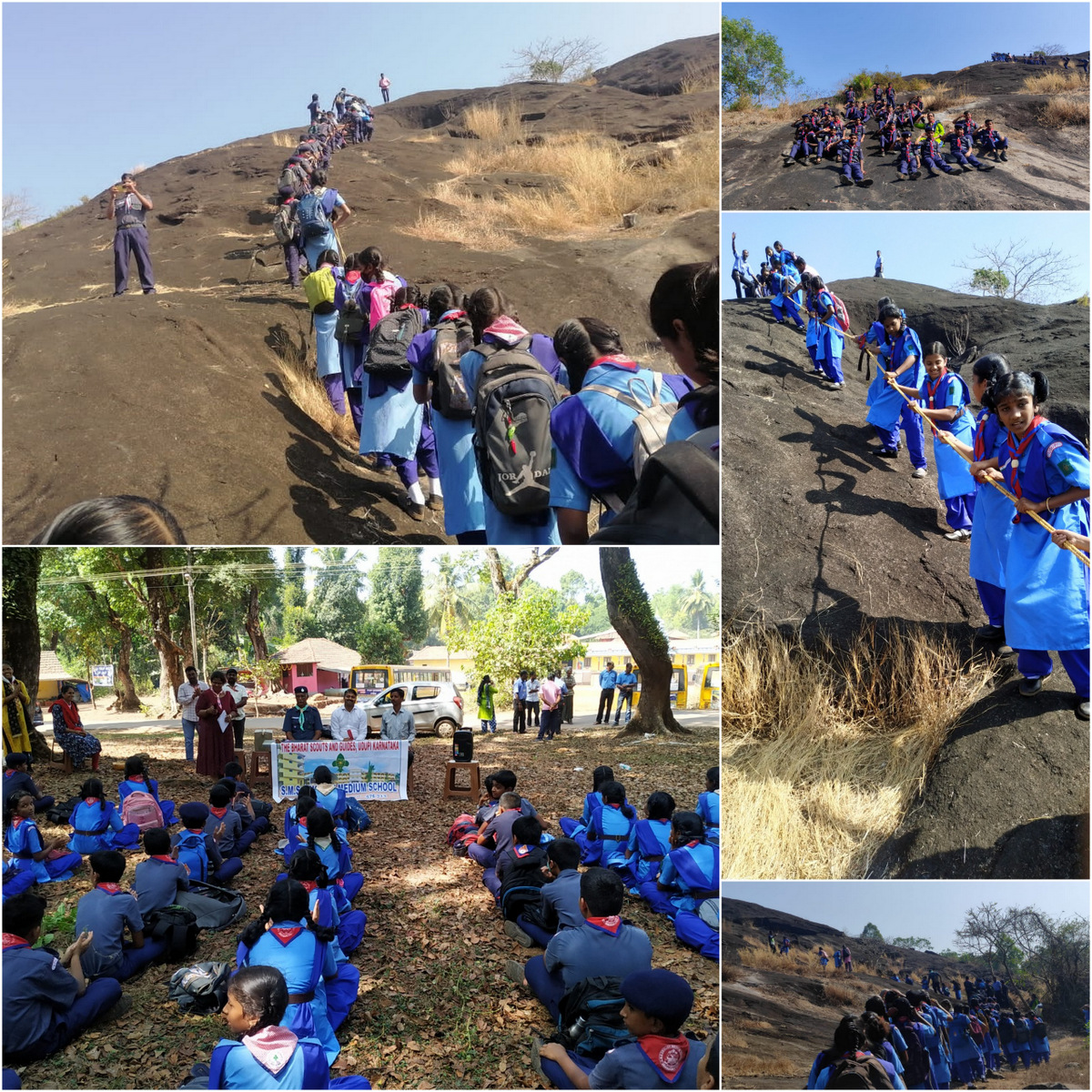
11 — Hike/Trek Readiness

Hikes and treks prepare Scouts for adventure and self-reliance. Being prepared ensures safety and fun!

  • Packing: water, snacks, first-aid mini kit, rain cover
  • Safety: buddy system, whistle, torch
  • Route card: record destination, time, return plan
  • Wear: cap, comfortable shoes, light clothes
Scouts on a hike

💡 Fun fact: Six whistle blasts repeated is the international distress signal!

12 — Flag Ceremony & National Symbols

Scouts must know how to respect the flag and national symbols. It shows discipline, unity, and patriotism.

  • Hoist flag correctly; never let it touch ground
  • Lower at sunset, fold respectfully
  • Stand at attention during National Anthem
  • Understand basic flag etiquette in parades
Scout flag ceremony

💡 Fun fact: In India, flag hoisting is done in the morning, but flag unfurling is done on Republic Day — a unique tradition!

All Quizzes

Try all mini-quizzes — they count towards your progress.